|
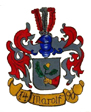
Origins and Meanings of the Marolf Surname Swiss/German Origins The Marolf family name is typically considered a Swiss surname by nationality and Old High German linguistically. The surname Marolf is classified as a patronymic name by The Historical Research Center, meaning it is a name derived from that of a paternal ancestor usually by the addition of one or more sounds or letters to the name to produce a derivative word or an inflectional form. The original function of patronymic names were to denote the "son of" someone, although they were later assumed to be hereditary surnames. Early Marolfs The earliest verified Marolf I have found thus far is Johannes Marolff, an attorney who was the rector of the University of Basel in 1490, according to the Die Matrikel der Universität Basel: Volume 1, 1460-1529 by Hans Georg Wackernagel. Interestingly, even though Johannes spent time in Switzerland, he was originally from Friedberg, Germany, and he returned to Germany after serving at the University of Basel and lived in Nuremberg. This may indicate that the Marolf family origins are ultimately German instead of Swiss, but I have not found enough evidence of this yet to be sure. In any event, the Marolf coat of arms found on record at the University of Basel Library was most likely granted to Johannes Marolf in 1490. My research has lead to two possible meanings for the name Marolf, both from Old High German. The first possibility comes from the old Markulf (which varies in spelling) composed of "marka" and "ulf" meaning Border Wolf. The second possible meaning of Marolf, which I have not yet verified, comes from the Germanic personal name Marwolf, formed from "mari/meri" and "wolf" meaning Famous Wolf. "Border Wolf" Origins
The origin of the surname Marolf meaning "border wolf" is supported by the research done by
The Historical Research Center.
The name Markulf was most likely a nickname given to someone based on their personality, specifically
someone who showed fierceness in guarding their territory.
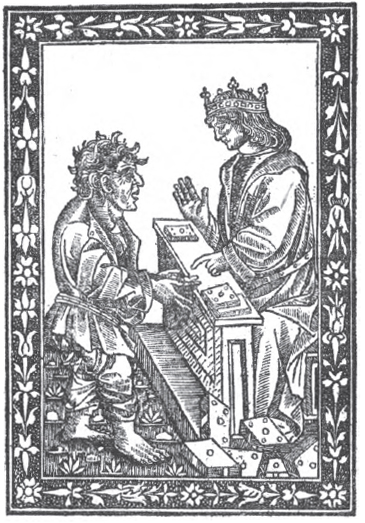
The peasant Marcolf
and King Solomon
The origins of the surname Marolf are easily linked to the Marcolf surname via the tale of
Solomon and Marcolf,
one of the more popular pieces of prose of the Middle Ages. This story pits King Solomon of Bible
(1 Kings),
son of David and Bathsheba, against the peasant Marcolf in a verbal discussion. Several versions of the tale exist
at different periods in history. Sometimes the dialogue between the two
characters is presented as a battle of wits, ripe with parody, and other times it takes the form of an exchange
of proverbs.
The Solomon and Marcolf story has taken many forms in many cultures, and the Marcolf character's name was
changed slightly each time to fit the linguistics of the native language of the people in that area, including
Latin, German, Middle English, Italian, and French.
However, the story ultimately has its origins in Anglo-Saxon, where the place of the Marcolf character was
originally held by the god Saturn.
Solomon and Saturnus
In the Anglo-Saxon version in the ninth century,
called
Solomon and Saturnus, Solomon engaged in the same dialog with
Saturn, the Roman god, instead of Marcolf.
It is a notable piece of literature serving as the cornerstone of deciphering the meaning of one of the sets of ancient
runes.
This text also brings about the question of the connection between the Saturn and Marcolf characters.
It is interesting to note that in Solomon and Saturnus, Saturn is mentioned as having travelled through
the land of Marculf, which was in the East between Media and the kingdom of Saul.
But what is the connection between Marculf and Saturn that might explain the replacement in latter texts?
Mercurius, God of Travellers and Boundaries
One scholar noted that the god Mercury was treated almost interchangeably with the god Saturn in another ancient text,
and one of the methods of worshipping both gods was by throwing stones into a pile. It is here that we start to
see how the name Saturnus was changed.
The Roman god Mercury was referred to as Mercurius in Latin and was the Roman equivalent of the Greek god
Hermes. Mercury was borrowed from them around
the 4th century BC, and shared many of the same attributes, such as serving as the god of travelers and trickery.
One of the ways the Greeks paid tribute to Hermes was by creating a pile of stones found at crossroads, milestones,
and boundary markers by tossing a stone onto the pile as they passed. Later, the Greeks made pillars with the bust of
Hermes on the top called hermai and used them as
milestones and boundary markers, continuing to toss stones at the base of the herms as they came across them.
The Romans also tossed stones into piles at crossroads and at boundaries in reverence to Mercury. Notice how Mercurius
and Marculf (as translated as "border wolf") were both connected to borders and trickery? These similarities
were likely well known among Germanic people of the time, who fought many wars with the Romans as they invaded the
Germanic tribes and expanded the Roman Empire.
The Idol Markolis
To make the connection even more clear, we need to look at the idol or god called Markolis by the Jewish people living
in Roman times. Interestingly, the Hebrew word markolis means "heap of stones", and the Jewish people had very
specific laws about the handling of stones used in the worship of Markolis, as can be found in the
Talmud.
As it turns out, the idol Markolis is actually a mistranslation of Mercurius, the Roman god Mercury. In translating
the Latin "Mercurius" to their own Hebrew, it went through some changes due phonetic differences.
Most notably, the second "R" was changed to an "L" sound due to a mechanism called
lambdacism or
lallation. Hence Mercurius was known to the Hebrews as
Merculius or Markolis (note the spellings here are the Anglicized versions of the Hebrew spellings, which give
rise to the many different English spellings of Markolis/Merculis/Merkulis, etc.).
In conclusion, you can now see where in the tale of Solomon and Saturnus, the god Saturn, having come from the land
of Marculf in the East may have been tied to Markolis, the Hebrew idol in the East, and to Mercury. A connection
to the name Marculf as having significance with boundaries and borders was made and a more familiar and meaning name
substituted for Saturn.
"Famous Wolf" Origins
It has also been suggested that the name Marolf comes from the Old High German name Marwolf, meaning "famous wolf".
These origins are noted in the Dictionary of American Family Names, and can be seen on Ancestry.com's webpage
for the Marolf Name Meaning and History.
At this time, I have not yet verified this assertion.
|